Garden Design Cost Cheshire: The 5 Hidden Factors That Decide Your Budget
Summary
There’s no single price for a new garden in Cheshire, because five things decide it: how much of the garden you change, how easy it is to get into, how much it slopes, what the ground is like underneath, and the materials you pick. The first and last are largely your choice. The other three come with the house, and a good part of the budget can go into work you’ll never see once the garden is finished.
Key Takeaways
- Built features such as patios, walls and steps cost more than planting and lawn, square metre for square metre
- If machinery can’t reach your back garden, more of the work is done by hand and the job takes longer
- A sloping garden usually needs retaining walls and steps, which are among the most expensive parts of any garden
- Heavy clay needs a deeper stone base, and sometimes drainage, before anything goes on top
- The stone you choose, and how it’s cut and laid, can change the cost of two patios of the same size considerably
Creative Gardens & Driveways has been designing and building gardens across Cheshire and the North West since 2001. In this post, we go through each of the five factors that influence garden design cost Cheshire in turn, explaining what pushes the cost up and what can bring it down, as well as sharing what a good garden design quote should show you.
Key Factors Influencing Garden Design Costs
Every garden is different, which is why two quotes for designs that look alike on paper can come back far apart. You can expect your garden design Cheshire costs to vary based on the following.
1. Scope sets the starting point
The more of your garden that’s built rather than planted, the more it will cost.
Think of the project as a scale. At the light end, you’re freshening up what’s already there: new planting in the borders or a new lawn. At the heavy end, you’re adding a patio, steps, walls, a pergola and lighting. Every one of those built features needs the ground dug out and a solid base put in before anything shows on top, and that’s where most of the money goes.
To determine which is necessary for your garden design project, start with how you want to use the garden. A spot for eating outside on summer evenings calls for something quite different from a garden you mostly look at from the kitchen window. Work that out early, and you won’t pay for features you never use.
A few extras are also best decided at the start. For example, a garden room or an outdoor kitchen needs a base of its own. A garden room usually needs a new electrical circuit too, and that has to be notified under the Building Regulations. Lighting is much easier to include while the garden is being built, because the cables run underneath the paving.
If a full garden design is more than you want to spend in one go, knowing what pushes the cost up makes it easier to choose what to keep and what to leave for later.
2. Access decides how much is done by hand
If a small digger can’t reach your back garden, the job takes longer and costs more.
Everything that comes out of your garden, and everything that goes in, has to travel between the road and the work. With a wide gate or a drive down the side of the house, a mini digger can do most of the heavy lifting. With only a narrow passage, or no way round the back at all, every load of soil and stone goes through by wheelbarrow, and that takes time, which in turn increases the garden design costs you’ll face.
In terms of access, consider:
- A side gate that is narrower than a small digger rules out machinery, however short the distance
- Steps between the road and the garden slow every barrow load, adding to more labour and time costs
- When work has to come through the house, you need to protect floors and doorways first, which can add more material and time costs to your project
- Where the skip goes matters: on your own drive it needs no permission, but on the road it needs a permit from your council’s highways team
If getting into your garden is tricky, it’s worth mentioning when you book your free consultation with Creative Gardens & Driveways, so access is planned into the design and the quote from the start rather than discovered on the first day.
3. Garden slopes and layout
A sloping garden usually needs retaining walls and steps, and these are some of the most expensive parts of any garden.
If your garden slopes, the garden design has to work with it. Turning a slope into flat areas you can actually use, such as a patio or a level lawn, means building walls to hold the soil back and steps to get from one level to the next. Those walls need proper foundations, and the soil that’s dug out either has to be reused somewhere in the garden or taken away.
A gentle slope can often be worked into the design without much fuss. A steep one tends to shape the whole layout, and the budget along with it.
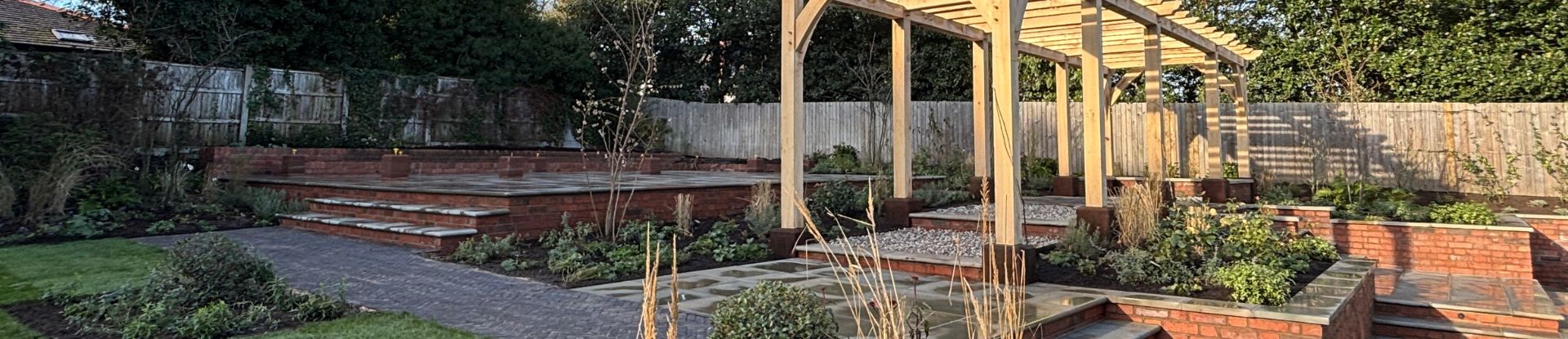
One of our gardens in Alderley Edge is a good example. The owners had a well-kept garden with one problem area, an overgrown rockery. That was replaced with a raised patio, held in place by a curving retaining wall in Corten steel, which turns orange over time, with stabilised gravel and new flower beds around it.
In a garden like this, most of the cost is in the wall and the groundwork rather than the patio itself.
Decking can sometimes be a cheaper way to deal with a slope, because it sits on a frame rather than needing a retaining wall. Bear in mind that under the permitted development rules set out by the Planning Portal, decking more than 300mm off the ground needs planning permission. That’s lower than most people expect, so it’s worth checking with your council before the design relies on it.
4. The ground underneath is the cost nobody sees
Heavy clay needs a deeper stone base than firm ground, so the same patio costs more to build on clay.
Paving sits on a layer of compacted stone, which is what stops it sinking. On firm, free-draining ground, that layer can be around 100mm deep. On heavy clay that holds water, it can need to be twice that. Double the depth means more digging and more stone, all before a single slab is laid.
Drainage is the other half of your garden design costs Cheshire. Clay that stays wet after rain may need drainage put in before anything else is built; otherwise, the new patio becomes the place water collects.
There are also the things nobody knows about until the digging starts, such as any old foundations, buried rubble from a previous owner’s project, tree roots, a forgotten drain. Not every garden has them, but a good quote says what happens if they turn up, so the cost doesn’t run away from you halfway through.
5. Materials are where your choices count most
Two patios of the same size can cost very different amounts because of the stone and how long it takes to lay.
Reclaimed York stone, Indian sandstone, granite and porcelain all sit at different points, so your choices matter when it comes to garden design costs Cheshire. Not only do the materials come with their own price tags, but so does their installation process.
For example, as porcelain absorbs almost no water, each slab needs a primer coat on its underside before it will stick to the bed beneath. That’s an extra step on every slab, and it shows in the labour.
To learn more about our material choices, see our post: 6 Tips for Choosing the Landscaping Materials: A Visit to London Stone.
How the stone is cut makes a difference to your garden design costs too. Calibrated stone is cut to an even thickness, which makes it quicker to lay than stone that varies slab to slab. A layout set at an angle to the house, or one with curves, means more cutting and more waste than a straight run. None of that is a reason to avoid them. It’s simply where the money goes.
The cheapest point to change your mind is before anything is built. At Creative Gardens & Driveways, we provide a 3D design of your garden with a walkthrough, so you can change materials before anything is built and see what a different stone does to the look as well as the quote.
What A Clear Quote Should Show You: Understanding Garden Design Costs Cheshire
A clear quote prices the groundwork separately from the surface, so you can see where the money is going.
If two quotes for the same garden come back a long way apart, it’s usually because each one assumes something different about the ground and the access, not because of the paving. A clear quote should tell you:
- How deep the stone base will be, and why
- Whether waste removal and skips are included
- What happens if the digging turns up something unexpected, such as old foundations or a buried drain
- Whether planting and lighting are in the price or added later
- Which parts carry the most groundwork, so you know where savings are possible
Asking about what your quote includes early on is a great way to determine whether you’re hiring a reliable garden designer and what kind of costs you can expect. For more questions worth asking, see our post: 10 Things to Ask Before Starting a Landscaping Project.
When you ask Creative Gardens & Driveways for a quote, you can expect:
- A free, no-obligation consultation, then a clear written quote
- A 3D design of your garden with a walkthrough before anything is built
- A mobile showroom we can bring to your home, so you can see and compare materials in person
- A setting out plan, marked on the ground before building starts, so the finished garden matches the design you priced
To learn more about the setting out stage and what happens before any digging begins, see our post: Setting Out Plans: Why They Matter in Professional Garden Design.
Why Choose Creative Gardens & Driveways?
At Creative Gardens & Driveways, garden design, landscaping and construction are handled by one team from start to finish.
Because the people who design your garden are part of the same team that builds it, there’s no handover between a designer and a separate contractor halfway through.
We’ve been doing this in Bramhall, Cheshire, since 2001, and these are the memberships and recognition behind that work:
- A full contracting registered member of BALI, the British Association of Landscape Industries
- A Marshalls Approved Paving Installer and an accredited landscape contractor on the Marshalls Register
- Winner of the Society of Garden Designers Designer & Landscape Contractor Award in 2024
- Featured on ITV’s Love Your Garden with Alan Titchmarsh
Our team is fully insured for garden and driveway work, and all of our work is guaranteed. If you’re looking for a garden designer in Cheshire, we work across Wilmslow, Alderley Edge and Prestbury as well as closer to home in Bramhall, Stockport and Hale.
Conclusion
The surest way to keep a garden design budget under control is to know where the money goes before the design is finished.
Scope and materials are the parts you control. Access, slopes and the ground underneath are worth understanding early, because they shape the cost whichever stone you choose. Knowing about them up front gives you a quote built on what’s actually in your garden, rather than on guesswork.
If a quote comes in above what you had in mind, ask which parts carry the most groundwork. Scaling back a raised terrace usually saves more than switching to a cheaper slab, because the wall and the digging behind it cost more than the stone on top.
Contact us today
If you’d like the access and the ground at your own house looked at before you settle on a budget, you can arrange a consultation through our contact page.
Frequently asked questions
Do I need planning permission for a garden room?
Often not, if it stays within the permitted development limits the Planning Portal sets out. It must be single storey, with eaves no higher than 2.5m. Within 2m of a boundary, it can’t be taller than 2.5m overall; further away, 4m with a dual-pitched roof or 3m otherwise. Outbuildings can’t cover more than half the garden. Flats and listed buildings don’t get these rights and conservation areas add limits, so check with your council.
Who is responsible for the waste taken away from my garden?
Whoever takes it must be a registered waste carrier, and you have a legal duty of your own to make sure your household waste only goes to someone authorised to take it. You can check a carrier for free on the Environment Agency’s public register before anything is loaded.
Is planting cheaper than paving?
Square metre for square metre, planting and turf usually cost less than paving and walls. There’s no foundation to dig and far less labour involved. A garden with more planting and less hard surface will generally come in lower, although good soil preparation is still worth paying for.
Can I keep parts of my existing garden to save money?
Often, and it’s worth raising at the first meeting. A healthy lawn or a mature tree can usually stay. Where the levels change around them, keeping them can mean more careful work by hand, which narrows the savings.